 Qalami
AI-assisted marking for schools
The marking is drafted.
The judgement is yours.
Photograph a class set of handwritten work. Qalami marks it against your rubric and drafts the feedback. You read it, change what you disagree with, and approve. Nothing counts until you do.
Three weeks. Forty papers. No card, so there is nothing to cancel.
Against your rubric
9 / 12
- Content
- 4 / 4
- secure
- Organisation
- 3 / 4
- secure
- Accuracy
- 2 / 4
- developing
Evidence for accuracy
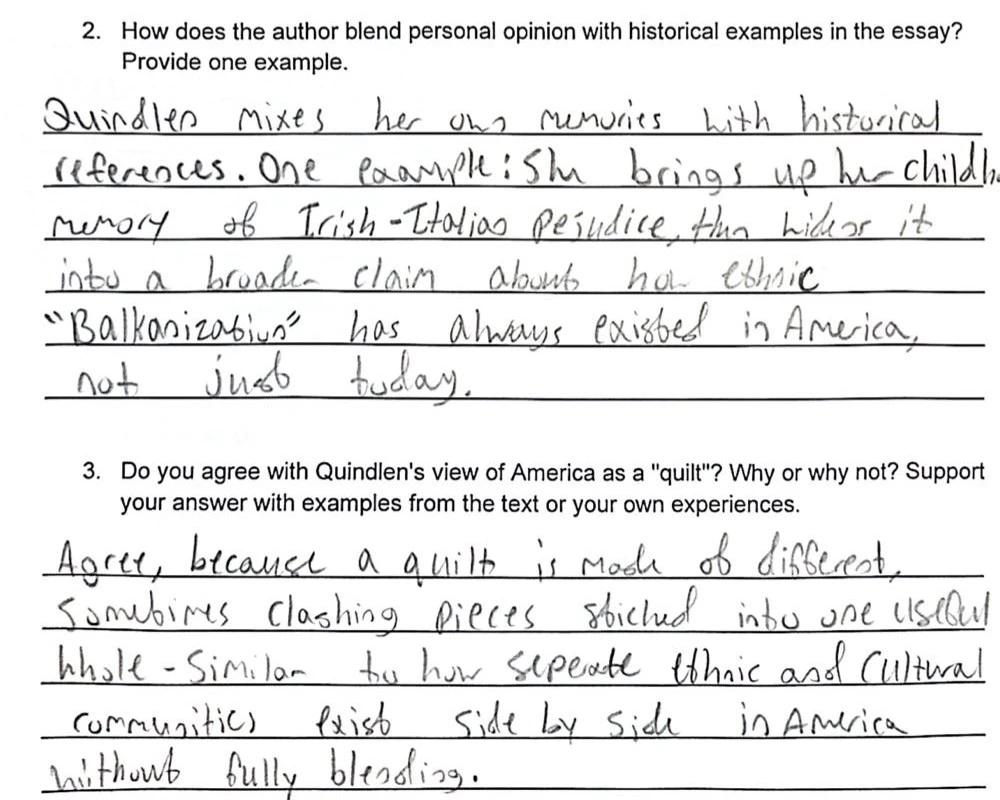
“stiched into one useful whole”

The part nobody budgets for
A class set is thirty papers. Then the feedback. Then the report the head of department asked for.
It arrives every week, and almost all of it gets done after the working day has already ended.
Qalami takes the first pass.
How it works
Four steps, and you are only needed for one of them.
Step one
Write the rubric once
Your criteria, your maximum marks, and your own description of what full marks look like. Qalami marks against that, not against a general sense of what good writing is, and every class you set up afterwards can reuse it.
Your rubric
Grade 9 · IGCSE First Language English
Content
4 marks
Full marks means: Answers the question with specific reference to the text.
Organisation
4 marks
Full marks means: A clear line of argument the reader can follow throughout.
Accuracy
4 marks
Full marks means: Spelling and punctuation do not interrupt the reader.
3 criteria12 marks in totalStep two
Photograph the papers
A phone camera is enough. Several pages per pupil, uploaded together, in whatever order they came off the desk. Handwriting is the hard part of this problem and it is the part the product is built around.
This assessment
28 papers
3 pages
Photographed on a phone and uploaded together, in whatever order they came off the desk.
- Amira Haddad3 pagesScored
- Yusuf Rahman2 pagesScored
- Lena Ahmed3 pagesReading
Step three
Read the draft. Change what you disagree with.
Every score arrives with the evidence it was based on, quoted from the pupil's own writing, so you are checking a claim rather than trusting a number. Confidence drops where the handwriting obscured the evidence, which tells you which paper to open first.
Awaiting your review
Amira Haddad · 12 of 28
Accuracy
2 / 4
“Somblines clashing pieces stiched into one useful whole”
Two misspellings in a single clause, and the sentence loses its subject.
Confidence0.68Lowered: the handwriting was unclear on the final line.
Approve this paperChange the markNothing counts until you doStep four
Hand back more than a number
Each pupil gets feedback written in a teacher's voice rather than a machine's. You get the class: which criterion is a whole-class teaching point, which one splits the room, and who to sit with whom. Both export as PDFs.
Class report
9B · 28 papers
Pupil Contentsecure Organisationvaries Accuracywhole class Total Amira Haddad secure secure developing 9 / 12 Yusuf Rahman secure developing emerging 7 / 12 Lena Ahmed secure secure developing 10 / 12 Daniel Okafor developing emerging emerging 5 / 12 Teach next
Accuracy is the only criterion where the whole class sits below secure. Organisation splits the room, so group rather than reteach.

The line that does not move
A teacher decides. Always.
Qalami never publishes a mark. It drafts one, shows you what it read, and waits. Approving is a deliberate act by a named person, and the record of who accepted or changed each mark is kept alongside the mark itself.
No mark is final until a teacher approves it
That is how the system is built, not a setting somebody could switch off in a hurry.
Every score shows its evidence
Quoted from the pupil's own page, so you are checking a claim rather than trusting a number.
Confidence falls where the page was hard to read
The papers that need your eyes most are the ones the app tells you about first.
The name
Qalami means “my pen”.
A pen is a small thing to name a product after, and that is the point. It does not replace the person holding it and it does not decide anything. It means the first pass is already done by the time you sit down with the class set.
Data protection
It holds photographs of children’s handwriting. We treat that as the serious thing it is.
Scans are deleted 90 days after a paper is approved
The marks and the feedback outlast them. The photographs do not.
Only your school's teachers can see your school's data
Enforced by the database itself, not by a setting we could get wrong.
Pupils' work is never used to train models
And nothing about your pupils is sold to anyone, ever.
No third-party fonts, no analytics, no trackers
While a teacher is marking, their browser talks to us and to nobody else. That is an answer a school's IT department can verify.
Your data leaves whenever you want it to
One archive with every record and every scan in it, in a form your IT team can open without our software.
Scans are private, and their links expire within the hour
A pupil's work is never sitting behind a URL that keeps working.

Try it on one class.
Three weeks, forty papers, and every feature rather than a cut-down version. We do not ask for a card, so there is nothing to cancel and nothing that quietly starts charging.
Any teacher on your school’s email domain can join the same trial.